
Uniform Aeration. Optimized Performance.
Insights & Resources
BacTee's resource library provides technical information, industry publications, and practical guidance related to odor control, biofilters, composting, and aeration systems.
Whether you're evaluating a new project or optimizing an existing facility, these resources are designed to help you better understand the technologies behind successful organics processing and odor management operations.

Why not pipe & gravel?

The BioAer® Floor System was developed to address the challenges of traditional biofilters.
Why settle for the limitation of pipe & gravel when BioAer® is available?
The Importance of Aeration
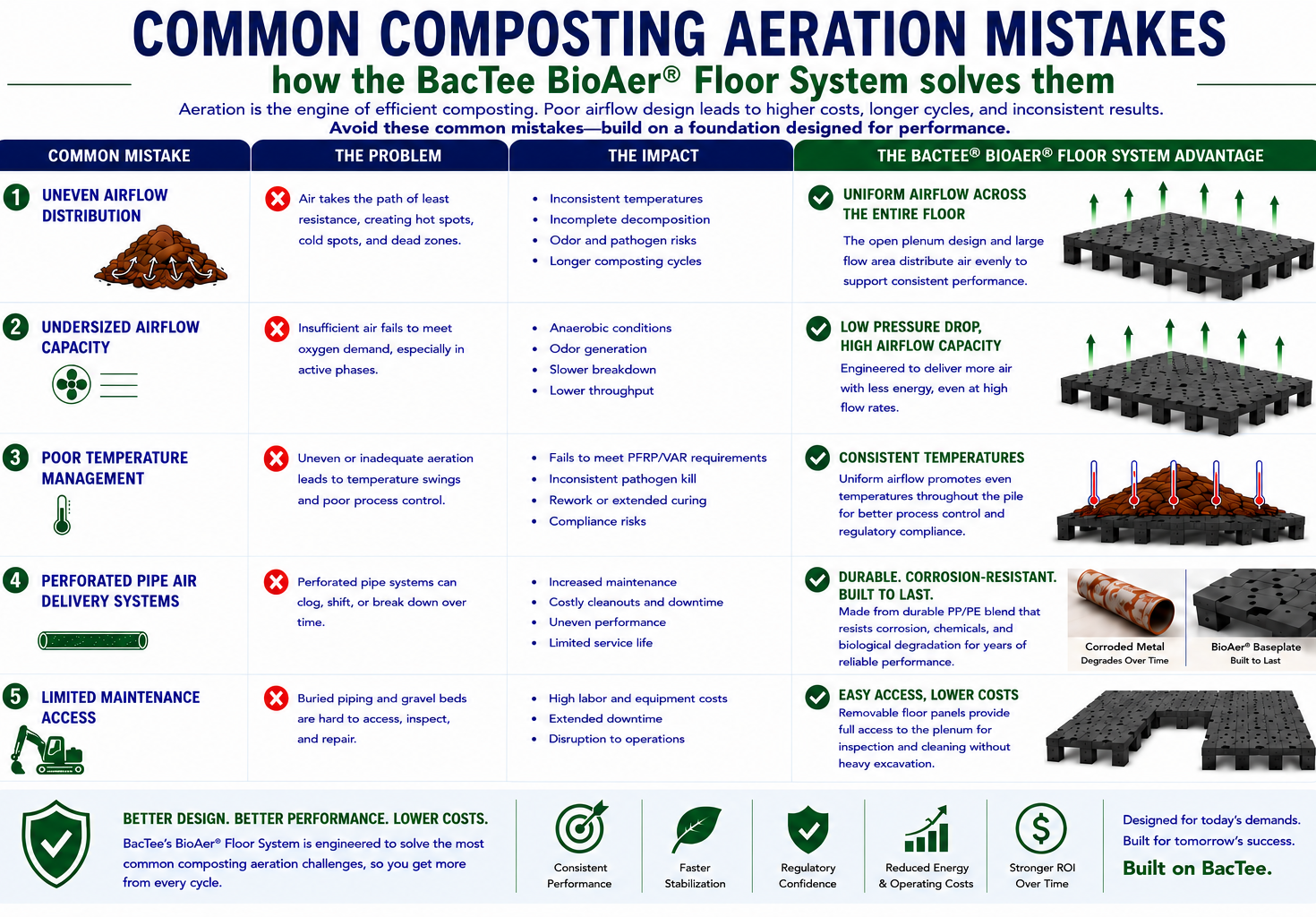
Uniform airflow drives better composting. BacTee's BioAer® floor system helps facilities improve process control, reduce maintenance, and maximize performance.


FAQs
Biofilter Questions:
-
Why are plenum floors superior to pipe-and-gravel systems?
-
Plenum floors provide more uniform airflow across the entire biofilter bed, reducing channeling and dead zones. The BioAer® Floor System also operates at lower pressure drop, reducing fan energy requirements while improving overall performance.
-
-
What media depth is recommended for a biofilter?
-
Media depth varies depending on airflow rates, contaminants, and project requirements. It can also depend on whether the facility uses organic or engineered media.
-
-
How does airflow uniformity affect biofilter performance?
-
Uneven airflow, also known as "channeling," creates areas of high and low treatment activity, reducing overall efficiency. Uniform airflow helps maintain consistent moisture, oxygen levels, and microbial activity throughout the media.
-
-
How often should biofilter media be replaced?
-
Media life depends on operating conditions and media composition but typically ranges from 3 to 10 years. Regular monitoring and maintenance can help maximize media longevity and system performance.
-
-
Can the BioAer® Floor System be retrofitted into an existing biofilter?
-
Yes, the BioAer® Floor System can be installed as part of a biofilter rehabilitation or upgrade project, replacing aging pipe-and-gravel systems and improving airflow distribution and maintainability. Often this can mean a smaller biofilter footprint for the same (or greater) biofilter efficiency.
-
Composting Questions:
-
Positive vs. negative aeration: which is better?
-
Both approaches can produce high-quality compost when properly designed and operated. The best choice depends on facility goals, process requirements, and odor management needs. BacTee can work with design engineers to evaluate the best solution for your facility.
-
-
How does aeration affect compost quality?
-
Aeration supplies oxygens to the microorganisms responsible for breaking down organic material. Proper aeration helps maintain aerobic conditions, control moisture and temperature, reduce odors, and produce a more consistent finished compost product.
-
-
Can the BioAer® Floor System be used with agitated bay systems?
-
Yes! In partnership with BDP Industries Inc., the BioAer® floor system has been successfully integrated into world class composting facilities utilizing automated agitation equipment. Its durable design allows material handling equipment and agitators to operate without the concerns associated with traditional pipe-and-stone aeration systems.
-
-
What is an ASP composting system?
-
ASP stands for Aerated Static Pile. In an ASP system, composting occurs in stationary piles while blowers provide controlled airflow through an aeration floor or piping network. ASP systems do not have the need for frequent turning while providing strong process controls and consistent composting conditions.
-
-
What are PFRP and VAR and how are they achieved?
-
PFRP (Process to Further Reduce Pathogens) and VAR (Vector Attraction Reduction) are regulatory standards used to ensure composted material is both safe and stable before use or disposal.
-
PFRP is the required process conditions (time + temperature) that eliminate pathogens during composting. VAR is the reduction of odor, instability, and pest attraction in finished material. BacTee's aeration solutions for composting support both by delivering uniform, controlled aeration that maintains thermophilic temperatures for PFRP and drives rapid biological stabilization for VAR through consistent oxygen distribution and reduced anaerobic goals.
-
-
Why is uniform airflow important in composting?
-
Uniform airflow helps maintain consistent oxygen levels and temperatures throughout the compost mass. This promotes more efficient decomposition, improves pathogen reduction, minimizes odors, and reduces the risk of wet spots, dry spots, or anaerobic conditons
-
General Questions:
-
How durable is the BioAer® Floor System?
-
The BioAer® Floor System is designed for long-term industrial use, engineered to withstand continuous loading, moisture, and corrosive environments.
-
-
Can heavy equipment operate on BioAer® floors?
-
Yes! The BioAer® Floor System is designed to support standard composting facility equipment, including front-end loads and turning machinery (for example, BDP Industries' composting agitators), when properly installed over a prepared structural base.
-
-
How are BacTee's systems maintained?
-
Maintenance is minimal and typically includes periodic inspection of aeration zones, airflow components, and surface condition, along with routine facility housekeeping to ensure consistent airflow performance.
-